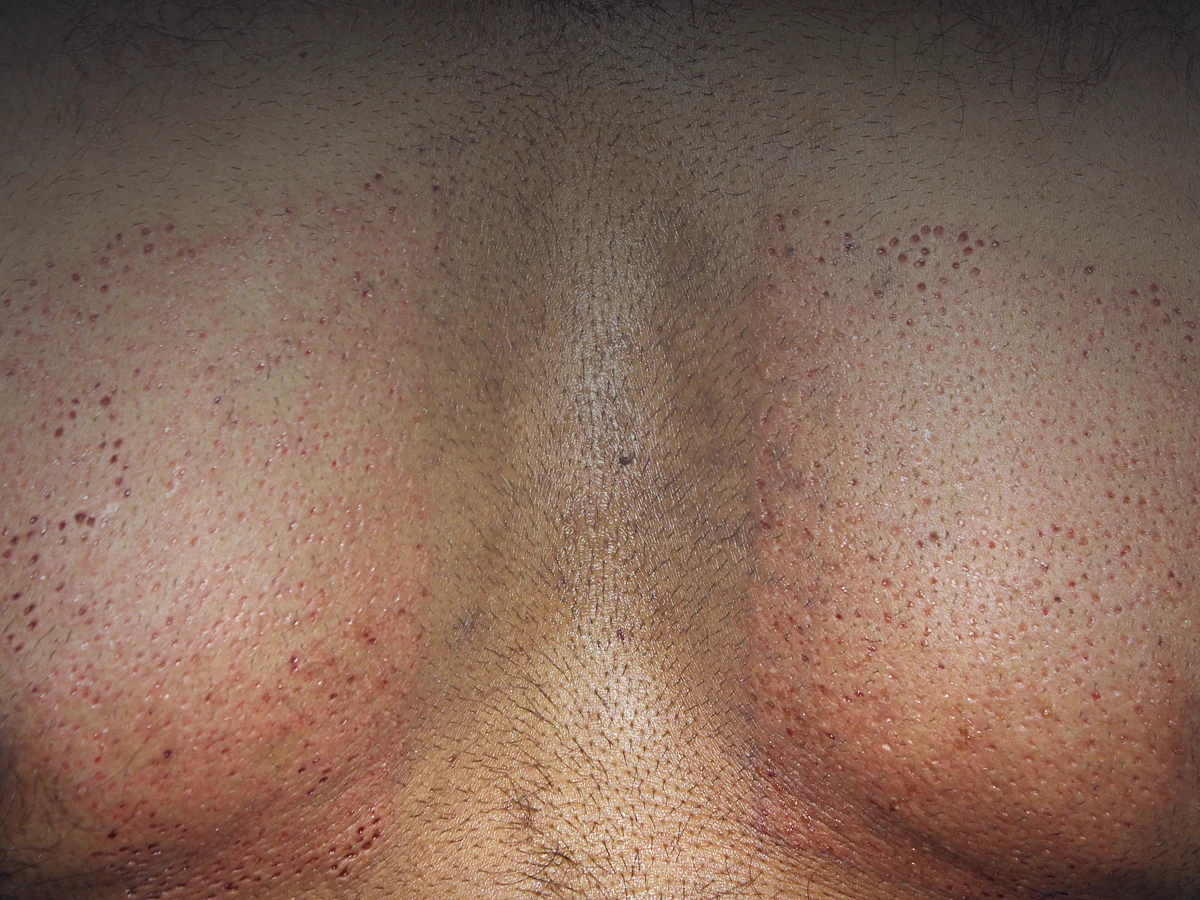
The complete guide to body hair to scalp transplantation: using beard hair on the scalp for crown balding and depleted donor areas, at Dr. Madhu's, Hyderabad
Body Hair Transplantation (BHT) is an advanced hair restoration technique used when a patient lacks sufficient donor hair on the back of their scalp. By harvesting follicles from the beard, chest, back, or limbs, surgeons can significantly expand the available donor pool to treat severe baldness, increase hair density, or camouflage scars from previous strip surgeries.
Because body hair has a different texture, a shorter growth cycle, and grows predominantly as single-hair follicular units rather than the 2- to 4-hair clusters found on the scalp, the success of the transplant relies heavily on sourcing and strict patient selection.
Since the beard is the strongest of these donor sites, the procedure is often called a beard and body hair transplant, or simply a beard to head or beard hair to scalp transplant. Its most common use is rebuilding a bald crown in patients whose scalp donor area has already been depleted.
Different areas of the body yield highly variable survival rates and textures:
Beard hair (the gold standard)
75%–95% survival
Beard hair is thick, robust, and has the highest survival rate (75% to 95%) among body hairs. Because of its coarse texture and large caliber, it is excellent for building dense volume in the mid-scalp and crown, though it is kept away from the delicate front hairline.
Chest and torso hair
50%–75% survival
Chest hair is finer and has a lower graft survival rate (50% to 75%). It is generally mixed with scalp donor hair to soften the look of a transplant or fill in localized bald patches.
Leg and arm hair
25%–60% survival
Considered a last resort, hair from the extremities is thin, grows slowly, and has the lowest survival rate (25% to 60%).
Beard to crown
Beard to crown: using beard hair on the scalp
The crown is where beard grafts do their best work. It is a large, swirling area that is mostly seen from above, so what matters most is coverage rather than the ultra-fine detail a hairline needs.
Why beard grafts suit crown balding
A thicker hair shaft covers more scalp per graft, and the natural wave in beard hair adds volume. That means beard grafts placed in the crown, usually alongside whatever scalp grafts are still available, give noticeably more visual density than the same number of chest or limb grafts.
Beard hair vs scalp hair: texture
Beard hair is coarser and often curlier than scalp hair, and it grows for a shorter period, so it does not reach the same length. Transplanted beard grafts keep these traits. In practice, crown hair from the beard may feel slightly wirier and works best for patients who wear their hair short to medium length. Mixing beard grafts with scalp grafts in the crown helps the two textures blend.
How many beard grafts for the crown?
The number depends on how large the bald crown is, how much scalp hair remains around it, and the density the patient wants. As a rough guide:
Approximate beard grafts needed for the crown
Crown balding
Approximate grafts
Small to moderate crown
1,000 – 2,000
Large crown (Norwood 6–7)
2,000 – 3,000 or more, often beard and scalp grafts combined
A full beard can supply a large share of this, but surgeons only take part of it so the beard still looks even afterwards. The exact plan is set at consultation. See hair transplant cost in Hyderabad.
BHT crown density results
Beard grafts in the crown follow the same timeline as any body hair graft, with the crown often filling in slightly more slowly than the front of the scalp. The realistic goal is a natural-looking, fuller crown that no longer shows bare scalp, rather than the density the patient had before hair loss. Some patients with very large crowns choose a second session for extra density.
The procedure
The FUE procedure
BHT is almost exclusively performed using Follicular Unit Extraction (FUE) to minimize visible scarring on the body.
1ExtractionThe surgeon uses a specialized micropunch tool under local anesthesia to carefully remove individual hair follicles from the donor site without creating linear scars.
2Graft ProcessingThe extracted follicles are cleaned, sorted by their hair count, and preserved in a specialized solution to maximize survival outside the body.
3ImplantationTiny incisions are made in the recipient area of the scalp. The body hair grafts are strategically placed at precise angles and depths to blend naturally with any existing scalp hair.
Visible growth typically begins between 4 and 6 months after the procedure, with the final, mature results visible at the 12 to 18-month mark. Once the follicles adapt, they continue to grow permanently, though they generally retain their original body hair characteristics (like curl pattern and maximum length).
Beard donor area recovery and scarring
In an FUE beard to head procedure, grafts are taken mostly from under the jawline and the neck, and spread out evenly so the beard does not look patchy. The donor area shows small scabs and some redness for the first few days, and the scabs usually fall off within 7 to 10 days. Most people are back to desk work in two to three days.
FUE leaves tiny dot-like marks instead of a line, and once the remaining beard grows back these are generally hidden. Temporary numbness or small bumps from ingrown hairs can happen and usually settle on their own. Taking too many grafts from one area can leave the beard visibly thinner, which is one more reason the extraction should be planned by an experienced surgeon.
Is it for you?
Requirements for candidacy
To determine if a patient is a viable candidate, surgeons evaluate them across several key clinical dimensions, often utilizing scoring systems like the Torso Donor Index (TDI).
Donor Hair DensityThe donor area must have greater than 40 Follicular Units (FUs) per square centimeter. A full beard can yield 3,000 to 5,000 extractable grafts, making it the most viable option.
Hair CharacteristicsThe closer the body hair mimics native scalp hair, the better it will blend. Surgeons look for hair that naturally achieves a length of at least 5 cm and has a caliber capable of matching scalp hair thickness.
Follicular Unit CompositionA strong candidate will have a higher percentage (ideally >30%) of follicular units containing 2 to 3 hairs. Because body hair mostly grows as single hairs, an abundance of multi-hair units drastically improves the visual density of the final result.
Target Recipient AreaThe patient must need coverage in the mid-scalp, crown, or for scar repair. Body hair is almost never used to reconstruct a front hairline, which requires fine, single-hair scalp grafts to look natural.
Patient ProfileBHT is reserved for patients with advanced hair loss (Norwood Grade 6 or 7) who have completely depleted their scalp donor area, or those needing corrective surgery.
Balanced view
Advantages and trade-offs
BHT offers the distinct advantage of expanding the donor pool for patients who would otherwise be turned away from surgery, allowing for full coverage and excellent scar concealment. However, the primary trade-offs include the risk of texture mismatch and lower overall graft survival rates. Because extracting body hair is technically demanding and the grafts are fragile, patients must have realistic expectations regarding the final density and rely on a highly experienced surgeon to ensure a natural aesthetic.
Jubilee Hills, Hyderabad
Beard and body hair transplant in Hyderabad at Dr. Madhu's
At Dr. Madhu's Advanced Hair Transplant Centre in Hyderabad, beard and body hair transplant (moving beard hair to the scalp) is offered to patients with a depleted scalp donor area, advanced crown balding, or scars from earlier strip surgery. Each case starts with an assessment of the beard and body donor areas, and in most crown cases beard grafts are combined with whatever scalp donor remains to balance density and texture.
Procedures are planned and performed under Dr. Pathuri Madhu, a Diplomate of the American Board of Hair Restoration Surgery and member of the International Society of Hair Restoration Surgery (ISHRS).
Beard and body hair transplant: frequently asked questions
Can beard hair be transplanted to the scalp?
Yes. This is called a beard and body hair transplant (beard to scalp). Beard hair is the strongest body hair donor, with a 75% to 95% survival rate, and its thick, coarse shaft suits the crown well. It is mainly used when the scalp donor area is depleted, and is kept away from the front hairline.
How many beard grafts are needed for the crown?
It depends on the size of the bald crown and how much scalp hair remains. As a rough guide, a small to moderate crown needs around 1,000 to 2,000 grafts and a large crown 2,000 to 3,000 or more, often combining beard grafts with any remaining scalp grafts. The exact number is decided at consultation.
Does the beard look patchy after a beard to head transplant?
When extraction is spread evenly and only a portion of the beard is taken, the beard does not usually look patchy. FUE leaves tiny dot-like marks that are generally hidden once the remaining beard grows back.
Does transplanted beard hair look different from scalp hair?
Beard hair is coarser and often curlier than scalp hair, and it keeps these traits after transplant, including a shorter maximum length. In the crown this extra thickness helps coverage, and mixing beard grafts with scalp grafts helps them blend.
Next step
Book a beard and body hair transplant consultation in Jubilee Hills
Suitability for body hair transplantation can only be confirmed after an in-person assessment. Patients visit us from across Hyderabad and India, and online consultations are available if you live outside Hyderabad.
This page is for general information and is not a substitute for a consultation. Suitability for body hair transplantation can only be confirmed after an in-person assessment by a qualified hair restoration surgeon.
Consultation
Consult Dr. Madhu's team
Send your hair loss details and scalp photos for an online evaluation, or speak directly with our doctors on WhatsApp or in-person in Jubilee Hills, Hyderabad.